
AI Search Optimization
AI search optimization: how to get cited in ChatGPT, Perplexity & AI search
AI search optimization (GEO) is the work of getting ChatGPT, Perplexity, Google AI Overviews and AI Mode to pick and cite your content.
Learn what Google says, which strategies work, and track your AI search performance with Mencoro.
Want to see where you stand first? Try the free AI visibility checker, no sign-up needed.
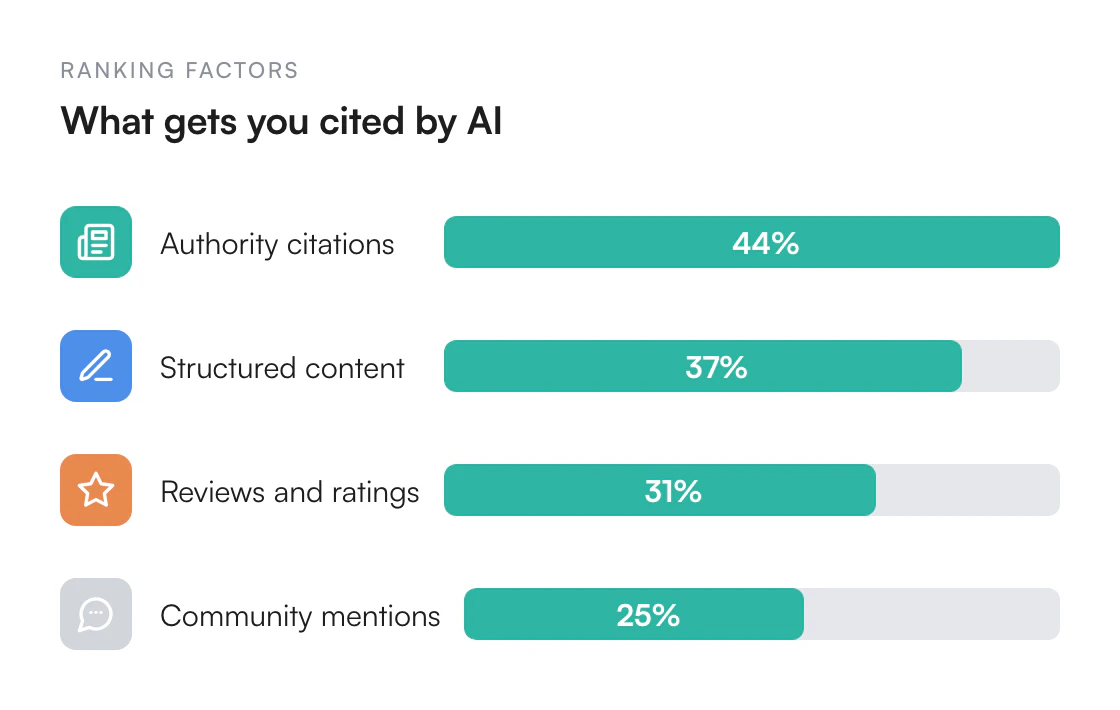
AI search ranking factors
AI search engines use different signals than traditional SEO. The key factors that determine whether your content gets cited in AI-generated answers include: content authority and E-E-A-T signals that demonstrate expertise, structured data markup using schema.org vocabulary, citation frequency across the web, topical expertise shown through comprehensive topic coverage, content clarity with direct answer formatting, brand reputation signals from mentions and reviews, and freshness of information. Understanding and optimizing for each factor is the foundation of effective Generative Engine Optimization.
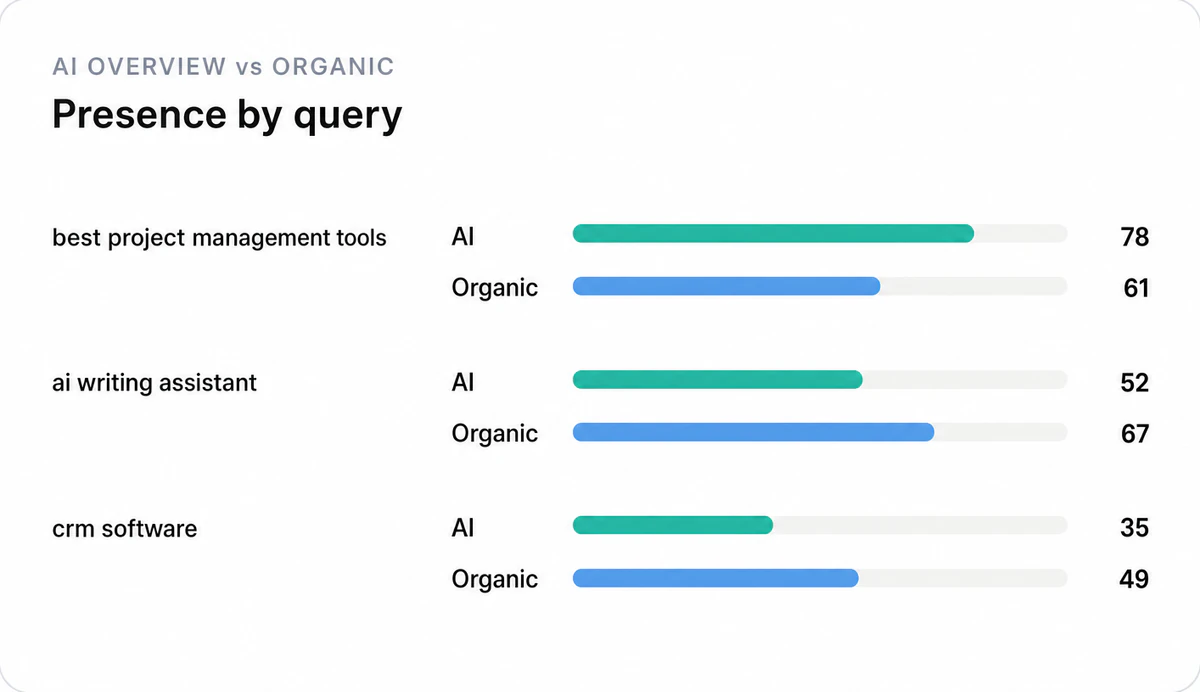
AI search vs traditional SEO: what's different
Traditional SEO focuses on ranking in a list of links. AI search optimization (GEO) focuses on getting your content cited as a source in generated answers. The strategies overlap but differ in critical ways: traditional SEO optimizes for clicks while GEO optimizes for citations, backlinks and keywords drive organic rankings while authority and structured data drive AI citations, organic competition is for positions 1-10 while AI competition is binary: cited or not cited. Measuring success also differs: organic uses position tracking while AI search requires monitoring mention frequency and citation context.
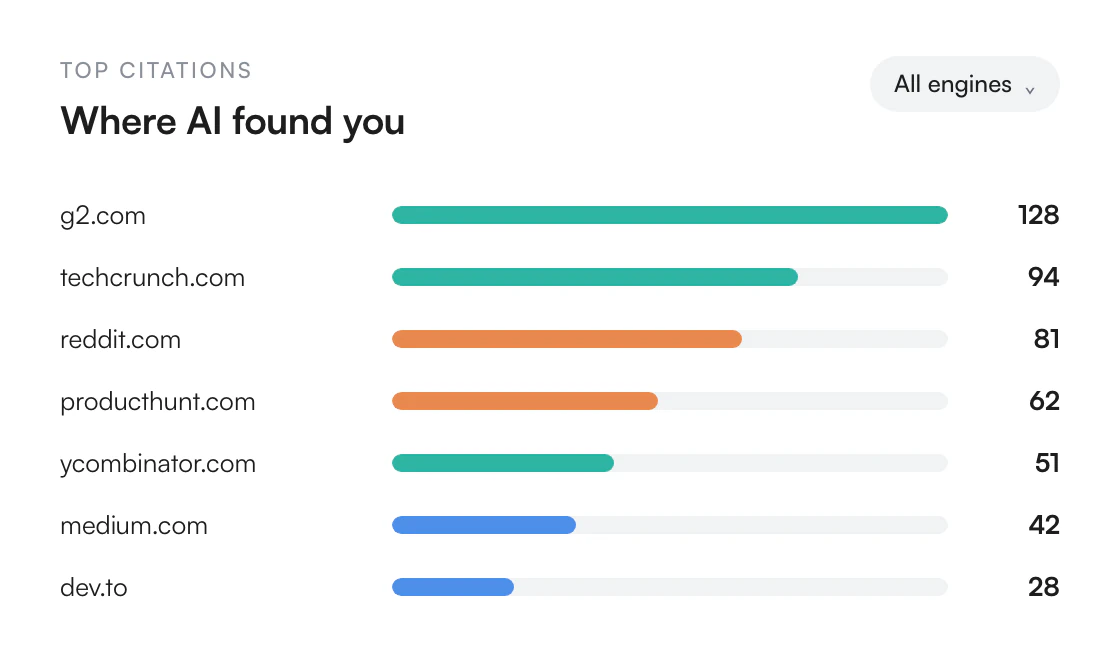
How to get cited in LLM responses
Getting cited in AI-generated responses requires a systematic approach. Follow these steps to improve your chances: first, create capsule content, direct answers of 40-60 words to frequently asked questions that LLMs can easily extract. Second, implement schema markup (FAQ, HowTo, Article) that matches your visible text, to help AI models understand your content structure. Third, build topical authority by publishing 5 or more in-depth articles on each core topic. Fourth, use original data and verifiable citations that make your content uniquely valuable. Fifth, format with clear headings and lists that AI models can parse. Sixth, publish consistently and keep content updated. Seventh, build a quality backlink profile that signals authority to both search engines and AI models.
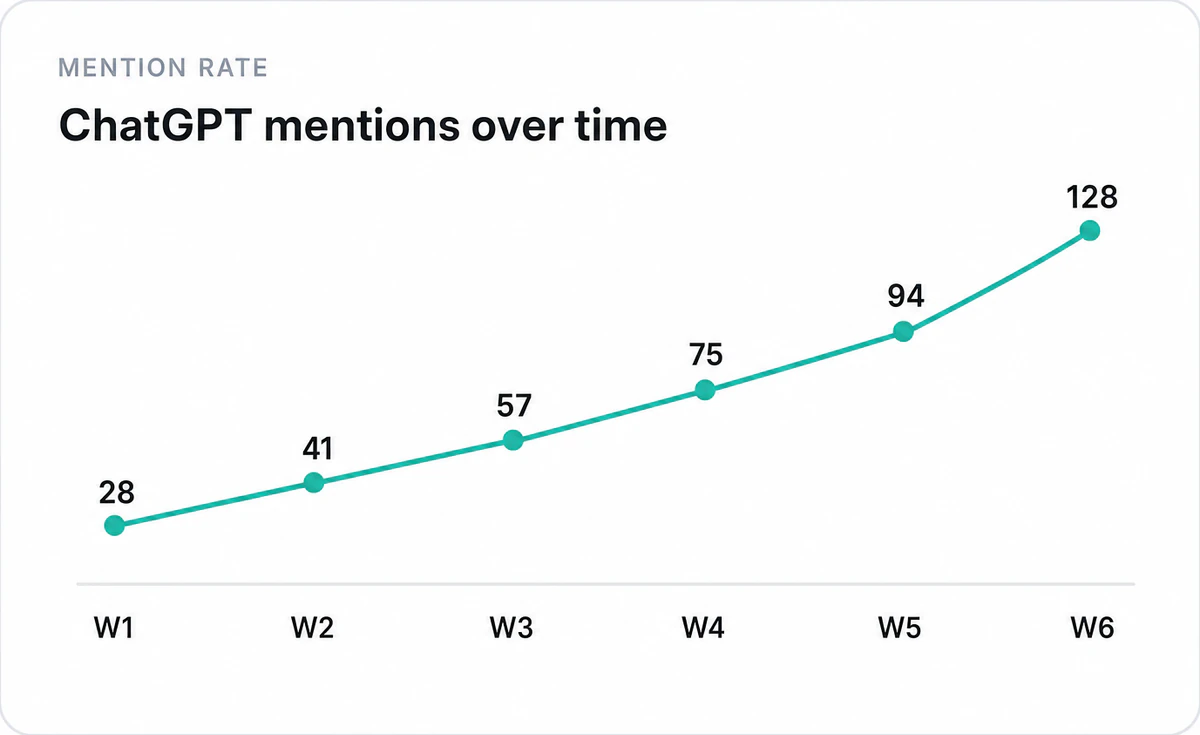
Track your AI search optimization progress
Use Mencoro to monitor how your optimization efforts translate into real results. Track AI mention frequency to see how often you're cited, mention breadth across different queries, citation context to understand how you're referenced, and your overall AI visibility score relative to competitors, built from Coverage and share of voice. Watch your progress over time. Comparing Coverage before and after each change tells you which part of your GEO work actually moves your mentions.
What is GEO and how it differs from SEO and AEO
GEO (Generative Engine Optimization) is the set of practices that gets a brand or its content mentioned, used as a source or cited in the answers generated by ChatGPT, Perplexity, Claude, Gemini, Google AI Overviews and Google AI Mode. The term comes from a 2023 research paper, "GEO: Generative Engine Optimization", presented at KDD 2024, whose visibility gains were measured on the authors' own benchmark rather than on live search engines. In practice, AI search optimization does not replace SEO: it extends it. It shares the foundation (helpful content, authority, crawling and indexing) and changes two things: where you compete and how you measure it.
| Discipline | Goal | Where you compete | How it is measured |
|---|---|---|---|
| SEO | Rank your pages in search results | The Google and Bing results list | Rankings, impressions, clicks and CTR |
| GEO | Get AI to name your brand and cite your pages as a source | Answers in ChatGPT, Perplexity, Claude, Gemini, AI Overviews and AI Mode | Mention rate, position in the answer, cited sources, share of voice and sentiment |
| AEO | Have your content answer a question directly | Featured snippets, voice assistants and answer engines | Questions where your page is the answer or the source |
For the details, read GEO vs SEO: what actually changes and our definitions of AEO, LLM SEO and query fan-out, the mechanism that turns a single question into several searches.
What Google says about AI search optimization
The most reliable source on Google's AI features is Google itself. Its documentation on AI features and your website and its guide to optimizing for generative AI features on Google Search (updated July 2026) boil down to this:
- No extra requirements. To appear as a link in AI Overviews or AI Mode, a page must be indexed and eligible to show in Search with a snippet. There are no extra technical requirements, and the July 2026 guide adds that your site must be included in Search's generative AI features in Search Console.
- It is still SEO. The generative features are rooted in the same ranking and quality systems as Search, so for Google, optimizing for them is doing good SEO.
- Non-commodity content. Google asks for a unique point of view and first-hand or expert experience (E-E-A-T), not summaries of what is already published.
- Clear structure, in text. Paragraphs, sections and clear headings, important content available as text, relevant images and video, internal links, and crawling allowed in robots.txt and by your CDN.
- Consistent structured data, not special markup. There is no schema.org markup for AI; whatever you use must match the visible text.
- Up-to-date business data. Keep your Google Business Profile and Merchant Center feed current.
- What you don't need. No llms.txt or "AI files" (Google Search doesn't use them), no chunking content into tiny pieces, no rewriting it with synonyms. Creating pages in bulk for every fan-out subquery can violate the scaled content abuse policy.
- Control and measurement.
nosnippet,data-nosnippet,max-snippetandnoindexlimit what is shown; Google-Extended limits the use of your content for training and grounding in some of Google's other systems, not crawling for Search. You measure these features in Search Console, which now has a generative AI performance report.
Two caveats. That guidance only covers Google: ChatGPT, Perplexity and Claude have their own crawlers (OAI-SearchBot, PerplexityBot or Claude-SearchBot) and their own sources, so check that they can read your site with the AI crawler checker, the robots.txt tester and the AI crawler index. And Google warns that no third-party tool has access to its internal ranking or AI systems. Neither does Mencoro: what it does is run your prompts and record what AI search engines answer and which sources they cite, which is exactly what can be measured from the outside.
Which AI search engines matter most in 2026
The AI search landscape includes several platforms with distinct characteristics. ChatGPT Search handles the highest volume of conversational queries and cites sources with direct links. Perplexity is the fastest-growing AI search engine, popular with technical and research-oriented users, and provides detailed source attribution. Google AI Overviews has the broadest reach through integration with Google Search but offers less direct citation opportunities. Bing Copilot leverages Microsoft's ecosystem and integrates AI answers directly into Bing results. Each platform has different citation patterns, and optimizing for one doesn't guarantee visibility in others, which is why Mencoro tracks your presence across all major AI search engines simultaneously. To see where you stand on each one today, use our free AI SEO tools: the ChatGPT and Perplexity rank checkers and the AI Overview checker.
How to improve visibility in AI search and earn more citations
This is the sequence we follow for AI search optimization, from the technical basics to measurement. Every step has a free tool or a guide so you can do it today.
- Let AI crawlers in. Review robots.txt, CDN and server with the AI crawler checker: if an engine can't read your page, it won't cite it.
- Secure the Google basics. Make sure the pages you want cited are indexed
and carry no
noindexornosnippet. - Measure your starting point. Run buying questions from your industry through the AI visibility checker and note which sites ChatGPT, Gemini and Perplexity cite: those are the sources you need to win.
- Publish information nobody else has. Original data, first-hand experience, a visible author and primary sources. It is what Google calls non-commodity content, and it is what gets cited most.
- Answer early, with structure. Headings that are real questions, the answer in the first lines of each section, and tables when you compare options.
- Build your entity beyond your site. Earn genuine mentions in the lists, comparisons and media that AI already cites, and make sure your brand is described the same way everywhere (entity SEO, AI brand mentions). Google warns that inauthentic mentions help less than they seem.
- Keep your markup consistent. Validate your structured data with the schema validator. If you want to publish an llms.txt, the llms.txt generator builds one from your sitemap, but it is not a ranking lever.
- Measure again with the same prompts. Answers change from one day to the next, so only consistent prompt tracking tells you whether your changes move citations. We explain what to measure in GEO metrics.
Common GEO mistakes to avoid
- Optimizing only for Google and ignoring AI engines. As AI search grows, brands that don't optimize for citations lose visibility to competitors who do.
- Writing long-form content without direct answers. LLMs prefer concise, citable responses. Bury your answer in 2,000 words of text and AI models will cite a competitor who answers directly.
- Ignoring structured data and schema markup. Google makes clear there is no special markup for its AI features, but Organization, Article or Product schema help engines understand who you are and what each page is about, as long as it matches the visible text. Check yours with our free schema validator.
- Not monitoring whether your AI mentions are positive or negative. Being cited in a negative context can harm your brand. Track citation sentiment, not just frequency.
- Copying your traditional SEO strategy without adapting it for GEO. AI search rewards different signals. A page ranking #1 in Google may never be cited by ChatGPT if it lacks clear, structured, citable content.
- Creating a page for every prompt variant. Google warns that mass-producing pages for AI fan-out subqueries can violate its scaled content abuse policy. One complete page per topic beats twenty clones.
Capsule content: the key to AI citations
Capsule content refers to focused blocks of text, typically 40 to 60 words, that directly answer a specific question in a format AI models can easily extract and cite. LLMs don't cite entire pages; they cite fragments. By structuring key information as self-contained, quotable blocks, you dramatically increase the chance of being selected as a source. For example, instead of writing 'There are many factors that influence AI search rankings, and these have evolved over time as models have become more sophisticated...' write 'AI search rankings are primarily influenced by seven factors: content authority, structured data markup, citation frequency, topical expertise, content clarity, brand reputation signals, and information freshness.' The second version is a citable capsule: concise, factual, and directly useful.
One nuance: Google says you don't need to chunk content for its AI. Capsule content is not a special format for machines; it is writing clear answers that serve a reader in a hurry as well as an engine looking for something to cite.
AI search rank tracking: how to measure your GEO
In AI search there is no fixed list of ten results: the same question can get a different answer tomorrow. That is why AI rank tracking doesn't measure a spot, but how often and how you are named when the same set of prompts runs on a regular schedule. Search Console only reports on Google, and your analytics only show part of your AI referral traffic.
Mencoro runs your prompts in ChatGPT, Perplexity, Claude, Google AI Overviews and Google AI Mode, tracks your Google rankings and, following its public methodology, calculates Coverage, Mention position, Link position, Favorability and Share of voice against your competitors, along with the sources each answer cites. Each query supports up to 3 passes and a daily, weekly or monthly schedule. Plans start at €15 a month for up to 200 checks, with no long-term contract: see pricing, the AI visibility feature or compare options in the best GEO tools.
What our data says about what AI search cites
Figures we measured on real AI answers and websites. Each one links to its study, with the method, the sample and the date.
-
72.6%
72.6% of the citations in AI answers go to company websites: competitors, shops, clinics and manufacturers.
Sample: 23,466 AI answers for 42 brands in Spain. Source: Mencoro (October 2026), in Which websites does AI cite in Spain? -
57.4%
57.4% of citations go to domains cited for one brand only: every market has its own sources.
Sample: 23,466 AI answers for 42 brands in Spain. Source: Mencoro (October 2026), in Which websites does AI cite in Spain? -
22,193
AI engines cited 22,193 different domains in 23,466 answers for 42 brands.
Sample: 23,466 AI answers for 42 brands in Spain. Source: Mencoro (October 2026), in Which websites does AI cite in Spain?
FAQ
AI search optimization questions
Common questions about optimizing for AI search engines
and Generative Engine Optimization (GEO).

Start tracking your brand in AI search today
Monitor how AI engines cite your brand, track keyword positions, and benchmark against competitors, all in one platform.