
Competitor Analysis
Competitor analysis: benchmark AI mentions, sentiment & share of voice
Compare how AI engines reference your brand vs competitors.
Track share of voice, sentiment, and mention types across every tracked query.
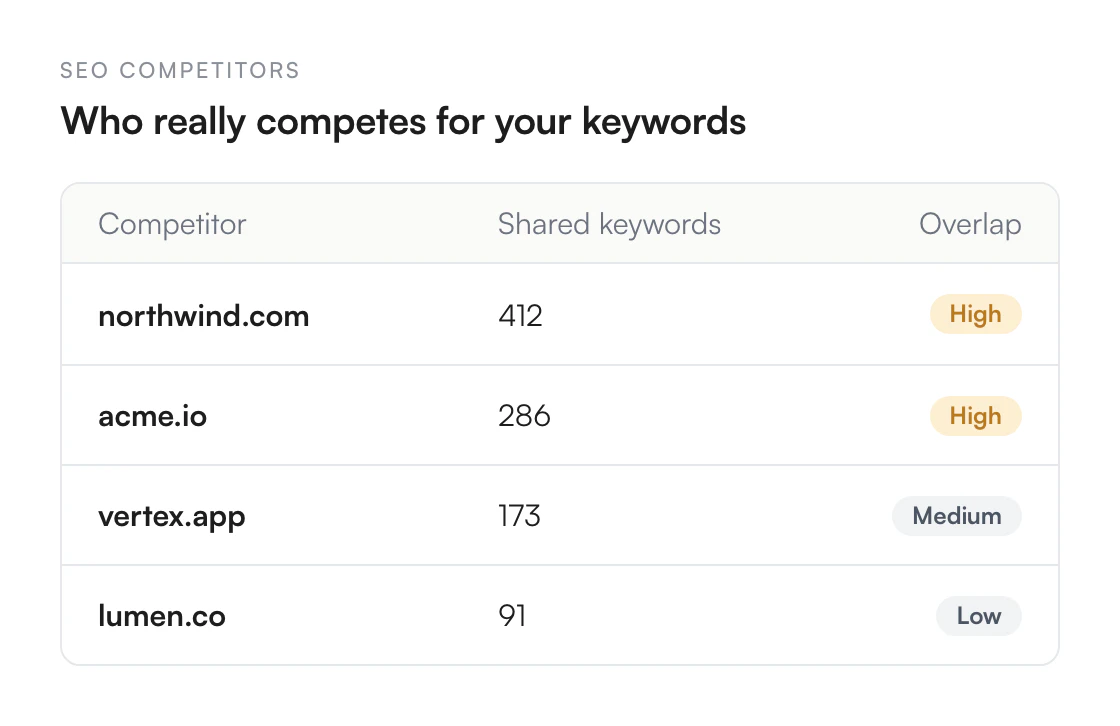
Discover your real SEO competitors
Your SEO competitors aren't always who you think. A publication like Search Engine Land could be your biggest SEO competitor without being a business rival at all. Mencoro analyzes keyword overlap to identify sites competing for the same search traffic. A high overlap percentage (above 30%) signals a direct SEO competitor worth monitoring. Prioritize competitors by real threat level based on overlap, ranking positions, and trajectory rather than assumptions.
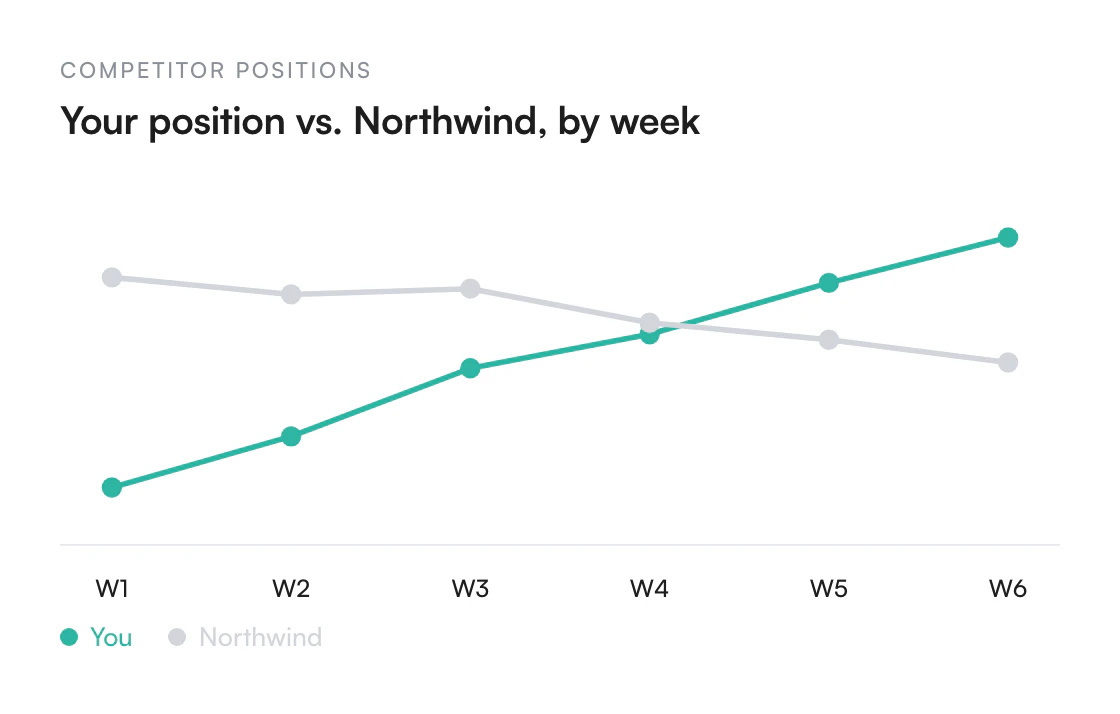
Track competitor keyword positions
Monitor competitor rankings alongside your own in a side-by-side comparison view showing your position vs each competitor for every tracked keyword. The movers report in the API and the MCP server compares each period with the previous one, so you can see which competitor entered the top 10 for your keyword or gained positions, or just ask your AI assistant what changed. Use this data to prioritize your content efforts: if a competitor gains position 1 for a high-value keyword, analyze what changed and respond.
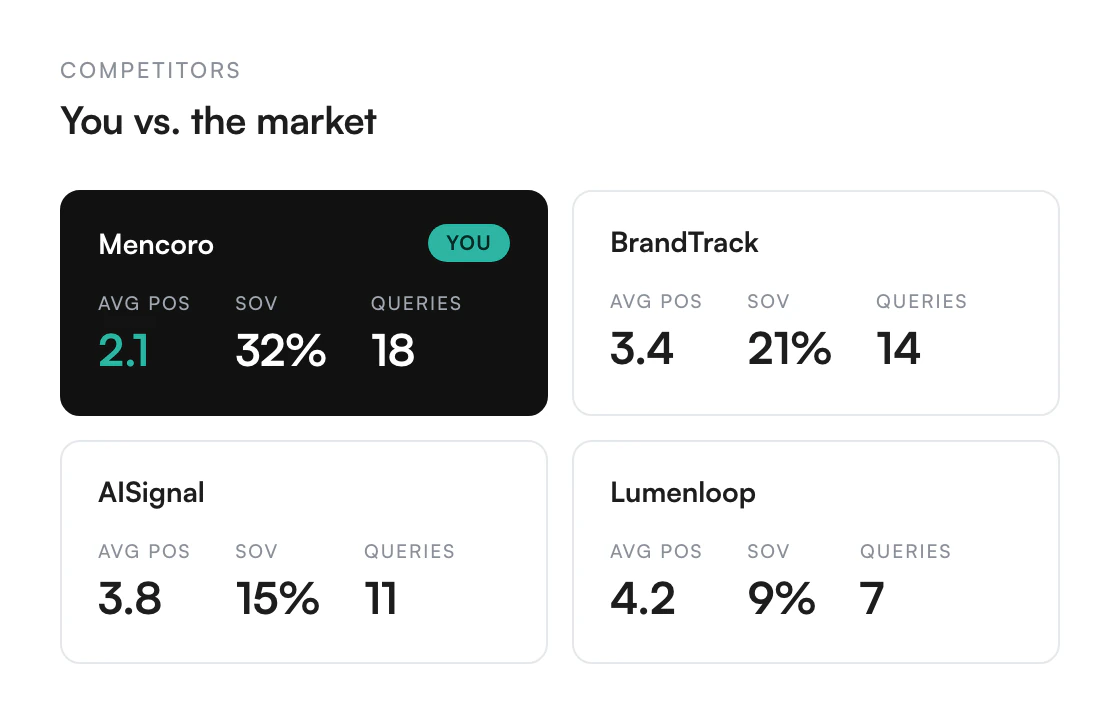
AI competitor benchmarking
Compare your brand's AI performance against competitors on the same tracked queries. See side-by-side metrics for each competitor: share of voice, mention rate, Favorability, sentiment breakdown (positive, neutral, negative), and mention type distribution (recommendation, comparison, listing, illustration, reference). For example, if a competitor gets 60% recommendation-type mentions while yours are mostly listings, you know exactly what to improve in your content strategy.
AI search competitor tracking
Your competitors in AI search can be completely different from your organic SEO competitors. Mencoro identifies which brands are cited in the same AI-generated responses as yours across ChatGPT, Perplexity, Claude, Google AI Overview, and Google AI Mode. Monitor whether a competitor starts being cited in queries where you were previously the referenced source, and track how share of AI mentions shifts over time. This gives you early warning when a competitor invests in AI search optimization and starts capturing citations that were previously yours.
Competitor benchmarking dashboard
Get a complete competitive overview in one view: a comparison table showing mention rate, Favorability, share of voice, average mention position, and mention type distribution for each tracked competitor. Data updates daily so you can spot trends as they develop. Extract actionable insights like "Competitor X increased their recommendation mentions by 20% in the CRM cluster this month" and prioritize your response based on business impact.
How to use competitor data to improve your SEO
- Analyze competitor mention types. If competitors get more recommendation-type mentions than you, study what content or brand signals drive that and adapt your strategy.
- Target low share-of-voice clusters. Identify query clusters where competitors dominate and build topical authority through targeted content to claim your share.
- Monitor sentiment shifts. When a competitor's Favorability drops, it may signal a reputation issue you can capitalize on with stronger positioning.
- Track competitor trends over time. Use daily rank data to spot when competitors gain or lose AI presence in specific clusters, and respond before the gap widens.
FAQ
Competitor analysis questions
Common questions about SEO competitor tracking
and competitive analysis features.

Start tracking your brand in AI search today
Monitor how AI engines cite your brand, track keyword positions, and benchmark against competitors, all in one platform.