 Alvaro Peña de Luna
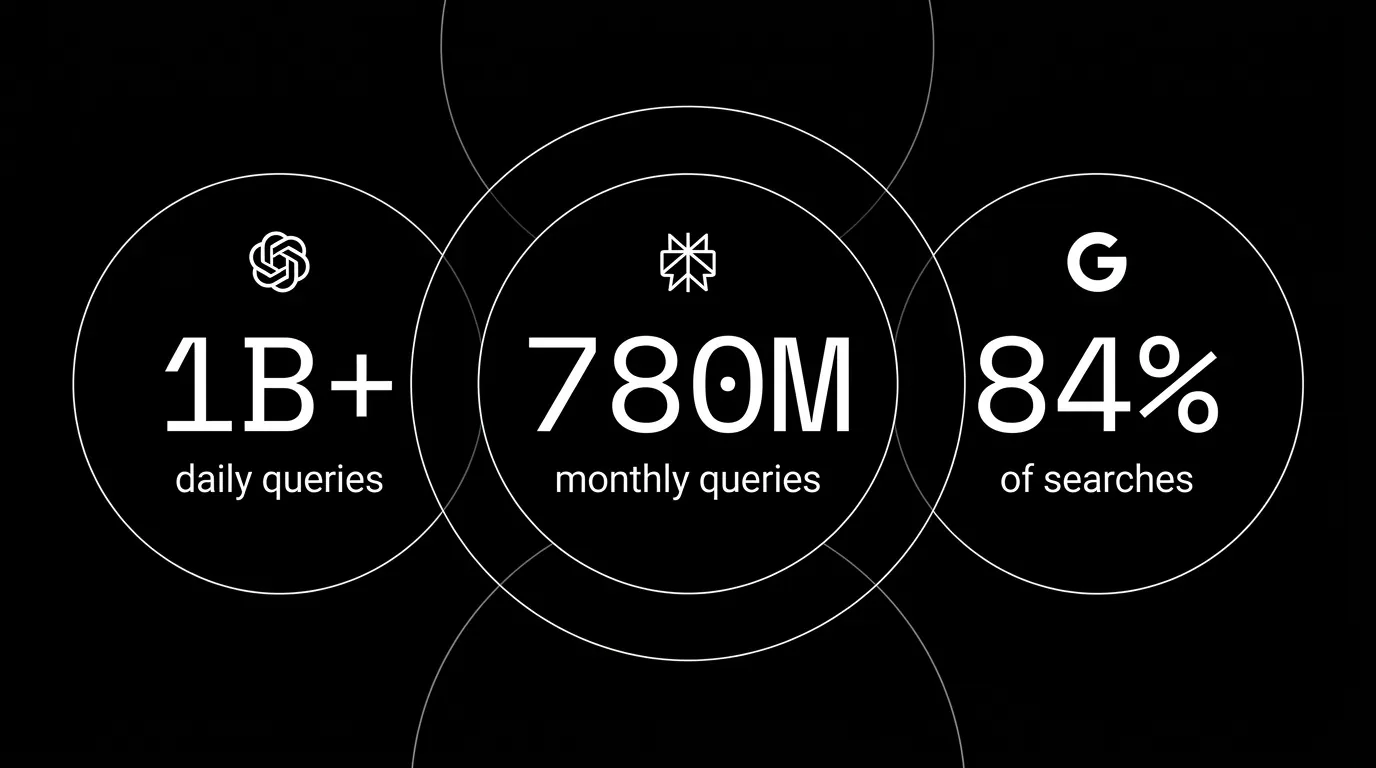
ChatGPT processes over 1 billion queries daily. Perplexity handled 780 million queries in May 2025, growing 20% month over month. Google AI Overviews appear in 84% of search queries.
When a user asks “what is the best AI visibility tracking tool” or “which platform should I use to monitor my brand in AI search,” these engines generate answers that mention, compare, and recommend specific brands. The question is: how much of that AI-generated conversation does your brand own?
That metric is Share of Voice (SOV) in GEO (Generative Engine Optimization).
What is Share of Voice in AI search?
Share of Voice measures the percentage of AI-generated responses where your brand appears compared to competitors for a defined set of queries.
In traditional marketing, SOV measures your advertising spend relative to the total market spend. In SEO, it measures the percentage of organic clicks you capture for your keyword set. In GEO, it measures how often and how prominently AI engines mention your brand when users ask questions relevant to your market.
The core formula looks simple:
SOV = (Your brand mentions / Total brand mentions across all competitors) x 100
If AI engines mention your brand in 30 out of 100 responses where competitors also appear, your SOV is 30%.
But this basic formula has a fundamental problem: it treats all mentions as equal. A direct recommendation carries the same weight as a passing reference. A positive comparison counts the same as a negative one. This makes the metric unreliable for decision-making.
Why simple mention counting fails
Consider two scenarios for the same query, “best AI visibility tracking tool”:
Scenario A: ChatGPT responds: “Mencoro is one of the most complete options for tracking brand visibility in AI search. It monitors mentions across ChatGPT, Perplexity, and Google AI with sentiment analysis and mention type classification.”
Scenario B: ChatGPT responds: “Several platforms serve this market, including Mencoro, Profound, Scrunch, and others. Mencoro is a newer entrant, though some users note its feature set is still evolving.”
In both scenarios, Mencoro gets counted as one mention. But Scenario A is a direct recommendation with positive sentiment. Scenario B is a listing with a cautious qualifier. The business impact is completely different.
A SOV metric that counts both as “1 mention” gives you a number, but not insight. You know your brand appeared, but you do not know whether that appearance helps or hurts.
This problem multiplies across hundreds of tracked queries. A brand with 40% SOV built on recommendations is in a fundamentally different position than a brand with 40% SOV built on references and negative comparisons.
The weighted approach to AI Share of Voice
A more useful SOV calculation weights each mention based on three dimensions: how the brand is mentioned (mention type), what tone is used (sentiment), and whether the recommendation is absolute or conditional.
Mention types
Not every mention carries the same influence. AI responses reference brands in structurally different ways:
-
Recommendation (weight: 1.0): The AI directly suggests or endorses the brand. “I recommend Mencoro for tracking brand visibility in AI search.” This is the strongest form of mention because the AI positions your brand as a solution.
-
Comparison (weight: 0.5): Your brand is compared against alternatives. “Mencoro offers sentiment analysis per mention, while Profound focuses on larger prompt volumes.” Comparisons signal your brand is in the consideration set.
-
Listing (weight: 0.4): Your brand appears in a list of options. “Popular AI visibility tools include Mencoro, Profound, Scrunch, and Peec AI.” Listings indicate presence but provide limited differentiation.
-
Illustration (weight: 0.3): Your brand is used as an example. “Tools like Mencoro have shown that weighted SOV metrics can provide more actionable data than raw mention counts.” Your brand is referenced for a concept, not as a direct recommendation.
-
Reference (weight: 0.2): A factual mention without endorsement. “Mencoro was launched in 2025 and focuses on AI brand monitoring.” Minimal commercial impact.
A weighted model assigns different values to each type. Recommendations carry five times the weight of references, because their commercial impact is proportionally different.
Sentiment
The tone of a mention changes its value:
- Positive sentiment (multiplier: 1.0): “Mencoro excels at classifying mentions by type, giving you actionable data.” Full weight.
- Neutral sentiment (multiplier: 0.7): “Mencoro offers mention type classification.” Reduced weight, since informational tone generates less brand preference.
- Negative sentiment (multiplier: 0.1): “Mencoro’s coverage is limited to five AI engines.” Heavily discounted. Negative mentions can actively harm brand perception, but they still represent presence.
Conditionality
Some recommendations are absolute, others are qualified:
- Unconditional (multiplier: 1.0): “Mencoro is the best tool for AI brand monitoring.” No qualifier.
- Conditional (multiplier: 0.7): “If you need detailed mention type classification, Mencoro is a strong choice.” The recommendation depends on a specific context.
Conditional mentions are less powerful because they only apply to users matching the stated condition.
How weighted SOV works in practice
Combining these three dimensions produces a weight per mention:
Mention weight = type_weight x sentiment_multiplier x condition_multiplier
Examples:
| Mention | Type | Sentiment | Condition | Weight |
|---|---|---|---|---|
| “I recommend Brand A for this use case” | Recommendation (1.0) | Positive (1.0) | None (1.0) | 1.0 |
| “Brand B is worth considering if you need enterprise features” | Recommendation (1.0) | Positive (1.0) | Conditional (0.7) | 0.7 |
| “Options include Brand A, Brand B, and Brand C” | Listing (0.4) | Neutral (0.7) | None (1.0) | 0.28 |
| “Brand C has faced criticism for slow support” | Reference (0.2) | Negative (0.1) | None (1.0) | 0.02 |
Weighted SOV = (Sum of your brand weights / Sum of all brand weights) x 100
This means a brand with 5 strong recommendations (total weight: 5.0) has higher SOV than a competitor with 20 neutral listings (total weight: 5.6), even though the competitor has 4x more raw mentions. The weighted approach surfaces the quality difference that raw counting hides.
How to measure AI Share of Voice
Measuring AI SOV requires three components: a query set, multi-engine tracking, and consistent measurement. To see how weighting changes the result on your own numbers, try the AI mode of our free share of voice calculator.
1. Build your query set
Your query set determines what you measure. A poorly chosen set produces meaningless data.
Start with these sources:
- Sales conversations. What questions do your prospects actually ask? CRM transcripts and sales call notes reveal the exact language users employ before purchasing.
- Support tickets. What problems do your existing users describe? These map to consideration-stage queries where AI engines compare solutions.
- Existing keyword data. Your tracked SEO keywords, filtered for informational and commercial intent, form a strong baseline.
- Competitor queries. Queries where competitors already appear in AI responses represent territory you should monitor.
Organize queries into topic clusters rather than tracking them individually. AI response volatility is high at the individual query level (40-60% monthly variation according to research), but cluster-level trends are more stable and actionable.
2. Track across multiple engines
Each AI engine behaves differently:
- ChatGPT includes external links in approximately 31% of responses. It relies heavily on parametric knowledge (training data) for many answers.
- Perplexity includes external links in 77%+ of responses. It performs real-time web search for most queries, making it more responsive to content changes.
- Google AI Overview integrates AI answers directly into search results. It pulls from Google’s index, so traditional SEO signals influence what gets cited.
- Google AI Mode generates longer, conversational responses within Google Search, combining search index data with LLM reasoning.
- Google SERP is still where the majority of search traffic flows. Tracking organic positions alongside AI mentions gives you the complete picture.
Your SOV will differ across engines for the same query. A brand with strong web content may dominate Perplexity (which searches the web in real-time) but be invisible in ChatGPT (which relies more on training data). Tracking per-engine SOV helps you understand where to invest. Dedicated AI visibility tools handle this multi-engine tracking for you.
3. Measure consistently and account for volatility
AI responses are non-deterministic. Research shows that GPT-4o produces identical responses only 3% of the time across repeated executions of the same prompt. This means any single measurement is a snapshot, not a fact.
To get reliable data:
- Track trends, not individual data points. A single day’s SOV is noisy. A 30-day rolling average reveals direction.
- Monitor volatility. Position volatility (how much your mention position fluctuates) is itself a useful metric. High volatility means your presence is fragile. Low volatility means it is consolidated.
- Alert on statistically significant changes. Small fluctuations are normal. Only changes that exceed the historical variance for a cluster deserve your attention.
What drives AI Share of Voice
Understanding what influences SOV helps you improve it. Based on how AI engines generate responses, these factors have the most impact:
Topical authority
AI engines favor brands that demonstrate deep expertise in a specific area. Publishing 5-10 comprehensive articles on a single topic cluster signals authority more effectively than publishing one article on 10 different topics.
If your SOV is low for a query cluster, check whether you have enough content depth in that area. The fix is often content creation, not technical optimization.
Third-party citations
AI engines cross-reference information across multiple sources. Brands cited by independent third parties (industry publications, review sites, comparison articles) receive stronger mentions.
This is why PR, guest posting, and getting featured in industry rankings directly influence AI SOV. A brand can appear in AI responses not because of its own website content but because multiple third-party sources cite it consistently.
Structured data
FAQ schema, HowTo schema, and Article schema help AI engines parse and cite your content. These structured formats make your content more easily extractable into AI-generated answers.
Content freshness
AI engines that search the web in real-time (Perplexity, Google AI Overview) prioritize recent content. Research suggests content older than 3 months shows declining citation rates. Regular publishing and updating existing content maintains freshness signals.
Brand recognition
Brands with strong recognition in an AI model’s training data receive more mentions from that model’s parametric knowledge. This creates a compound effect: the more you are mentioned today, the more likely you are to appear in future training data, which increases future mentions.
This also means SOV improvements from content changes may take time to reflect in models that rely on parametric knowledge (like ChatGPT), while showing faster results in models that search the web (like Perplexity).
AI SOV vs traditional SEO metrics
AI Share of Voice complements traditional SEO metrics but measures something fundamentally different:
| Dimension | Traditional SEO | AI Share of Voice |
|---|---|---|
| What it measures | Keyword positions in search results | Brand presence in AI-generated answers |
| How it changes | Gradually, tied to algorithm updates | Can shift rapidly as models update |
| What influences it | Backlinks, content quality, technical SEO | Brand authority, structured data, content citability, third-party mentions |
| How to improve | Optimize content, build links, fix technical issues | Create citable content, build authority, use schema markup |
| Measurement reliability | High (rankings are deterministic) | Moderate (AI responses are non-deterministic) |
A brand can have high organic visibility but low AI SOV, or vice versa. Tracking both gives you the complete picture of how users discover your brand across all search channels.
Using SOV data for strategic decisions
The value of SOV is not the number itself but the decisions it enables:
Identify competitive threats early
If a competitor’s SOV in your core topic cluster increases from 15% to 30% over a month, that competitor is investing in AI search optimization. You can investigate what changed (new content, PR coverage, product updates) and respond before the gap widens.
Prioritize content investment
Cluster-level SOV shows you where to invest. A cluster where you have 10% SOV but competitors average 30% represents opportunity. A cluster where you already lead at 45% may need maintenance rather than growth investment.
Measure the quality of your presence
The mention type breakdown tells you how you are perceived, not just whether you are mentioned. If your SOV is built on recommendations, your brand is positioned as a trusted solution. If it is built on listings and references, you have visibility but lack differentiation. Shifting from listings to recommendations in a cluster requires different content than simply increasing mention count.
Track sentiment trends
A declining Favorability score (positive mentions count fully, neutral half, negative zero) in a group may signal a reputation problem. Even if your SOV percentage stays stable, a shift from positive to negative mentions means AI engines are starting to reference concerns about your brand. This is an early warning that traditional analytics would not surface.
Getting started
If you are not measuring AI Share of Voice today, start with these steps:
-
Define 20-30 queries across your core topic clusters. Use existing keyword data, sales conversations, and competitor research as sources.
-
Choose your engines. Track at least ChatGPT and Google SERP. Add Perplexity, Claude, Google AI Overview, and Google AI Mode for comprehensive coverage.
-
Establish a baseline. Run your first measurement and record your SOV per cluster and per engine. This is your starting point.
-
Monitor weekly. Daily data is noisy. Weekly cluster-level trends give you actionable signals without alert fatigue.
-
Focus on mention types. Pay attention to the distribution of recommendations, comparisons, listings, illustrations, and references. Your goal is to shift toward higher-impact mention types, not just increase raw count.
AI search is growing fast, and the brands that measure and optimize their presence now will compound their advantage as these platforms scale. Share of Voice gives you the metric to track that progress and make data-driven decisions about where to invest.